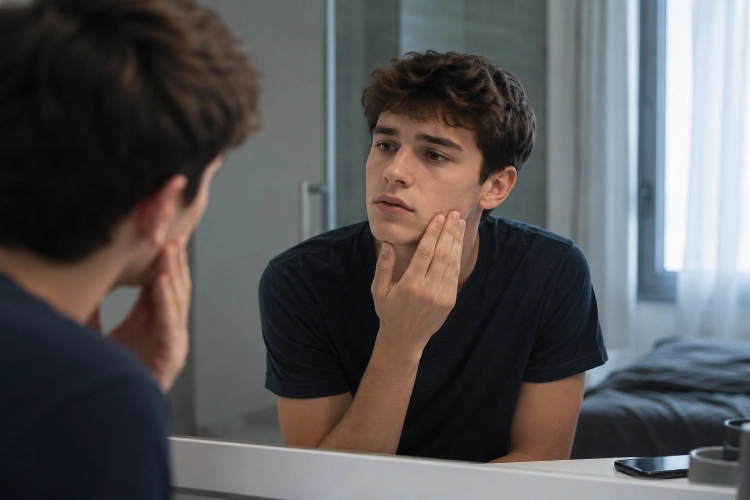
There is a word many parents have never heard, but many children and teenagers already know: looksmaxxing.
At first glance, it can sound almost harmless. Skincare. Haircuts. Fitness. Better posture. Dressing well. Learning how to feel more confident. Those things, on their own, are not the problem. Wanting to care about appearance is not new, and it is not inherently unhealthy.
But looksmaxxing is different.
Looksmaxxing is an online culture built around the idea that a person should “optimize” their appearance as much as possible, often in pursuit of a very narrow, idealized version of beauty or masculinity. For boys and young men, this may center on a sharper jawline, lower body fat, more muscle, clearer skin, greater height, or a face and body that look closer to a filtered, curated, algorithm-approved ideal. At its most benign, looksmaxxing may appear to involve grooming, skincare, fitness, or style. But in more troubling corners of this culture, the pursuit of optimization can move far beyond ordinary self-care. In clinical practice, and in the online content many adolescents are consuming, this pursuit of optimization can move far beyond skincare, grooming, or fitness. It can include cosmetic procedures, steroid use, dangerous stimulant use, and even self-injury aimed at changing facial structure.
Perhaps the most disturbing part is the way pain and harm can be reframed as discipline, commitment, or self-improvement. In these spaces, vulnerable adolescents may encounter the idea that damaging their own bodies is a reasonable price to pay for a sharper jawline, a leaner face, or features that better match an online ideal. Some young people are even being exposed to content that presents methamphetamine as a tool for becoming thinner or more facially “defined,” turning a highly addictive and medically dangerous stimulant into something falsely packaged as appearance optimization. That is not self-improvement. That is a dangerous distortion of what it means to care for oneself.
That is where this becomes frightening.
Because this is no longer just a teenager comparing themselves to a celebrity in a magazine, which was bad enough! This is a child with a developing brain being shown endless images, videos, rankings, routines, before and after transformations, and commentary about what is “wrong” with their face or body. The feedback loop is immediate, the content is tailored with unsettling precision, and the standards are unrealistic, creating a pressure that can feel constant and inescapable.
We are entering uncharted territory.
For too long, eating disorders in boys and young men were underrecognized, misunderstood, or missed entirely. Much of the conversation around body image focused on girls, thinness, dieting, and weight loss, and while those concerns still matter deeply, they were never the whole story. We are now seeing a growing number of males struggling with eating disorders, including many who do desire weight loss or thinness. But looksmaxxing adds another layer. For many boys, the pressure is no longer only about being thin. It is about being lean, muscular, angular, disciplined, and visibly “optimized.” The focus may be on body fat, muscle definition, facial structure, supplements, exercise, or constant body checking. And because these behaviors can be framed as fitness, confidence, or self-improvement, the distress underneath can be easily missed or considered a “fad”.
As a physician who cares for children and adolescents with eating disorders, this worries me tremendously.
It worries me because teenagers often do not describe this as distress. They describe it as self-improvement, saying they are simply trying to become healthier, stronger, more attractive, or more confident. But over time, what begins as an interest in appearance can become consuming. A teenager may spend hours researching skincare, jaw exercises, body fat percentages, protein goals, supplements, or workout plans, while gradually becoming more rigid with food, more compulsive with exercise, more preoccupied with mirrors and photos, and more withdrawn from normal life. What looks like discipline on the surface may, underneath, be a child who feels they are not good enough yet.
And because the language sounds like discipline, parents may miss the suffering underneath.
There is a meaningful difference between healthy self-care and a child becoming consumed by the belief that their body or face must be fixed. Healthy self-care usually makes a child’s life bigger. It supports confidence, connection, flexibility, and wellbeing. Looksmaxxing, when it becomes obsessive, often makes a child’s life smaller. It can narrow their food choices, their social life, their sense of worth, and their ability to feel comfortable in their own skin. The medical risks can be very real. Extreme restriction, rapid weight change, over-exercise, dehydration, stimulant or supplement use, purging behaviors, and unmonitored attempts to alter body composition can affect the heart, blood pressure, hormones, growth, puberty, sleep, mood, concentration, and bone health. Steroids and other appearance-enhancing substances can carry serious risks as well, especially when used by adolescents without medical supervision. These concerns are not theoretical. They are increasingly part of the world our children are navigating.
The U.S. Surgeon General has warned that social media is not proven to be sufficiently safe for children and adolescents, and that social media use is nearly universal among teens. The advisory also notes evidence connecting social media use with body image concerns, disordered eating, social comparison, and low self-esteem. That matters because looksmaxxing does not exist in isolation. It exists inside a digital environment that can repeatedly tell a child: your jaw is not sharp enough, your skin is not clear enough, your body is not lean enough, your muscles are not big enough, your face is not symmetrical enough, your height is not enough, you are not enough. No child should have to grow up under that kind of microscope.
Parents do not need to panic every time a teenager becomes interested in grooming, fitness, or appearance. But we do need to pay attention when that interest becomes rigid, consuming, or distressing. Warning signs may include sudden preoccupation with appearance, frequent mirror checking or body comparison, distress about specific facial or body features, avoidance of photos or social events, rigid eating, compulsive exercise, interest in supplements or steroids, secrecy around online content, or noticeable changes in mood, sleep, school performance, confidence, or social connections.
The most important question is not simply, “Is my child trying to look better?” The better question is, “Is this starting to cost them their health, their joy, their flexibility, or their sense of self?”
Looksmaxxing is scary because it takes normal adolescent insecurity and feeds it through an endless machine of comparison. It gives children a vocabulary for self-criticism before they have the maturity to understand what they are consuming. It can make dangerous behaviors look aspirational. It can make obsession look like discipline. And it can make a struggling child feel as though the problem is their body, when often the problem is the pressure being placed on that body. They need parents, clinicians, therapists, dietitians, coaches, and schools to understand that body image distress in boys is real, eating disorders in boys are real, and online appearance culture can be deeply harmful even when it is packaged as motivation.
Our children deserve better than this!
We are still learning what this new appearance culture will mean for children and teenagers, but we do not need to wait until a child is medically unstable or deeply entrenched in disordered behaviors before we take it seriously. Early recognition and compassionate attention can make an enormous difference, especially in a landscape where the message children receive online is often that they are a project to be perfected. They need to hear something steadier from us: that they are not a face to perfect, a body to optimize, or a collection of features to correct, but a whole person deserving of care, protection, and belonging.
U.S. Surgeon General. Social Media and Youth Mental Health Advisory.
American Academy of Pediatrics. Social Media and Adolescent Mental Health.
Nagata JM et al. Research and clinical commentary on boys, young men, digital media, eating disorders, and muscle dysmorphia.
Recent reporting on looksmaxxing and adolescent risk.