There are some things you can only understand after sitting with enough children and families in their hardest moments.
For years, I have cared for children and adolescents in traditional medical settings and saw just how devastating eating disorders can be, not only for the child, but for the entire family. I saw the fear in parents’ faces, the exhaustion, the confusion, and the helplessness that comes from trying to navigate a serious illness that is often misunderstood. I also saw something else: how much families needed not just medical expertise, but steady guidance, thoughtful coordination, and a place where they felt truly supported.
Over time, it became clear to me that I wanted to create something more personal, more responsive, and more intentional. That vision became The Conrad Clinic.
I started this practice because I believe children and adolescents with eating disorders deserve highly specialized medical care in an environment that feels calm, private, and supportive. I want families to have access to a physician who understands the medical complexity of these illnesses, but who also understands the emotional weight they place on daily life. I wanted to create a space where patients could feel safe, where parents can ask hard questions, and where care can move at the pace these illnesses often demand.
Eating disorders affect far more than eating. They can impact the heart, blood pressure, hydration, hormones, growth, bone health,mood, and a person’s ability to function day to day. They require careful medical oversight, but they also require compassion, consistency, and a team-based approach. One of the most important parts of my work is helping families make sense of what is happening medically while also partnering with therapists or psychologists, dietitians, psychiatrists, and other professionals involved in care. When a family does not yet have that team in place, I help build one, thoughtfully individualizing a team that is the best fit for the patient and family based on my knowledge of the eating disorder community.
I also wanted to create a practice that helps keep children and teens at home, connected to their families, schools, and daily lives whenever it is medically appropriate to do so. That is not only a personal value of mine, but one that is supported by the literature. In their review of outpatient treatment for anorexia nervosa, Frostad and Bentz note that outpatient treatment is often the best setting for early intervention,that inpatient care is more disruptive and costly, and that even some patients with severe illness may be safely treated as outpatients when they are medically stable. They also describe family-based treatment as the most empirically supported intervention for children and adolescents, emphasizing that the family is a resource and that parental involvement plays a pivotal role in treatment success. They further note that family-based treatment has been associated with a lower need for hospitalization and highlight the importance of supporting families so that their child can stay home and still receive the day-to-day support recovery requires. That perspective resonates deeply with the kind of care I wanted to build at The Conrad Clinic: specialized, medically thoughtful care that supports healing while keeping families closely connected to the recovery process whenever it is safe to do so.
Families facing eating disorders are often already carrying more than enough. In the midst of fear, uncertainty, and constant decision-making, they need more than medical information alone. They need clarity, steadiness, and experienced guidance from someone who can help them navigate a complex illness with both expertise and calm. A central part of my work is providing that kind of support, helping families feel anchored,informed, and less alone as they move through decisions that can otherwise feel overwhelming. At the same time, whenever it is safe and medically appropriate,I work hard to help children and teens remain connected to the lives,relationships, and routines that matter most to them.
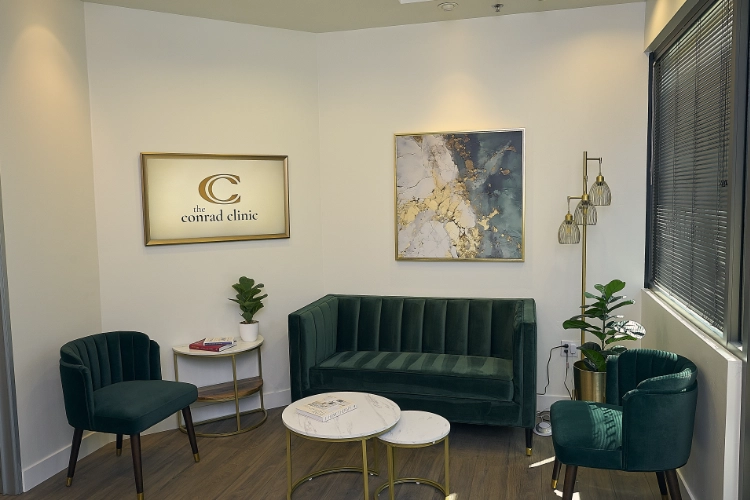
The physical space of The Conrad Clinic matters deeply to me as well. I wanted it to feel entirely different from the rushed,impersonal atmosphere of so many medical settings. From the beginning, it was important to me to create an environment that feels private, calm, and thoughtfully supportive from the moment a family arrives, with a private entrance, easy parking, and a setting that does not feel like a large medical office. Inside, I chose comfortable, home-like furnishings and designed multiple private spaces where patients and families can gather, talk, or simply exhale, rather than sitting in a large waiting room. Even the smaller details were intentional: soft cloth gowns, bathrobes and slippers, and a cart filled with supportive items such as fidget spinners, stress balls, journals, and coloring materials. While I have seen one patient grab a stress ball with each session, I have seen another one sit in the kitchen drinking a sparkling water while journaling at the kitchen table. Seeing my patients relaxed and comfortable in my office has been deeply rewarding. I also felt strongly that families should be greeted by someone at the front desk who understands the language of eating disorders and can offer warmth, reassurance, and support to parents. Healing is not defined by tests, vitals, and treatment plans alone. Environment matters. Privacy matters. Feeling safe, understood, and genuinely cared for matters.
The Conrad Clinic was created to provide expert medical care for children and adolescents with eating disorders, along with something equally important: partnership, support, and a place where families can begin to feel grounded again.